
Point of View & Insights
Dome Consulting publishes perspectives on the future of marketing-services businesses, including AI, agency economics, operating models, leadership, and investment implications.
Four-Part Series: The Future of Marketing Services, Intelligence, and Competitive Advantage
Part I: The Autonomous Marketing Era (March 2026)
Part II: The Marketing AGI Inflection (April 2026)
Part III: The Quantum Marketing Leap (May 2026)
Part IV: The Intelligence Race (June 2026)
Summary
The central conclusion of the white paper is straightforward: in the autonomous marketing era, the most valuable asset a brand may increasingly possess is its autonomous marketing intelligence system. The paper argues that agencies and brands are moving from disconnected workflows and retrospective analysis toward systems capable of ingesting data continuously, predicting outcomes probabilistically, generating strategic responses, and optimizing performance over time.
What readers will gain
A clearer lens on where agency economics are heading
A framework for evaluating next-generation agency value
Implications for private equity investors
Implications for independent agency owners
A practical perspective on AI beyond the hype
Part I: The Autonomous Marketing Era
A Paradigm Shift for the Marketing Services Industry
Part II: The Marketing AGI Inflection
The Near-Term Disruption the Marketing Services Industry is Not Prepared For
Summary
The Marketing AGI Inflection examines the next major disruption facing the marketing services industry: the rise of near-AGI systems capable of automating judgment across strategy, analysis, and creative decision-making. The paper argues that this shift will reshape agency business models, challenge traditional private equity assumptions, and increase the strategic importance of proprietary data, decision infrastructure, and intelligence systems. For agency leaders, investors, and brands, it presents near-AGI as an immediate competitive issue, not a distant future scenario.
What Readers Will Gain
A practical understanding of what near-AGI means and why its business impact is already unfolding.
Insight into how near-AGI changes the agency model by automating judgment, not just tasks.
A clearer view of how the AGI inflection pressures the private equity thesis in marketing services.
An understanding of why the AGI transition is likely to arrive before practical quantum marketing capability.
A strategic framework for what leaders should do now to strengthen competitive position and prepare for what comes next.
Part III: The Quantum Marketing Leap
The Missing Computational Layer for Autonomous Marketing Intelligence
Summary
The Quantum Marketing Leap examines the missing computational layer that will determine whether autonomous marketing intelligence becomes a practical competitive reality or stalls at the edge of what current infrastructure can support. Quantum computing is not a replacement for AI. It is the enabling infrastructure that makes full integration of the five modes of marketing intelligence viable at the scale of human decision complexity. For agency leaders and investors, quantum is not a future consideration. It is arriving now, and the firms that begin building toward it will hold the systems that cannot be bought later.
What Readers Will Gain
A clear explanation of what quantum computing is, why it matters to marketing, and how it differs from the AI systems already in use.
How quantum completes the three-layer architecture, and why the five modes of marketing intelligence cannot fully integrate without it.
Which marketing functions, specifically optimization, probabilistic modeling, and analogical reasoning, quantum will disrupt first, and where proprietary systems will either compound or collapse.
How quantum capability will concentrate competitive advantage among firms that build proprietary intelligence systems early.
What to evaluate now: the build decisions that will determine whether your intelligence systems are defensible when quantum capability reaches the market.
The Algorithm That Will Finally Understand You
Why the Five Modes of Marketing Intelligence Are the Foundation for What Comes Next
Summary
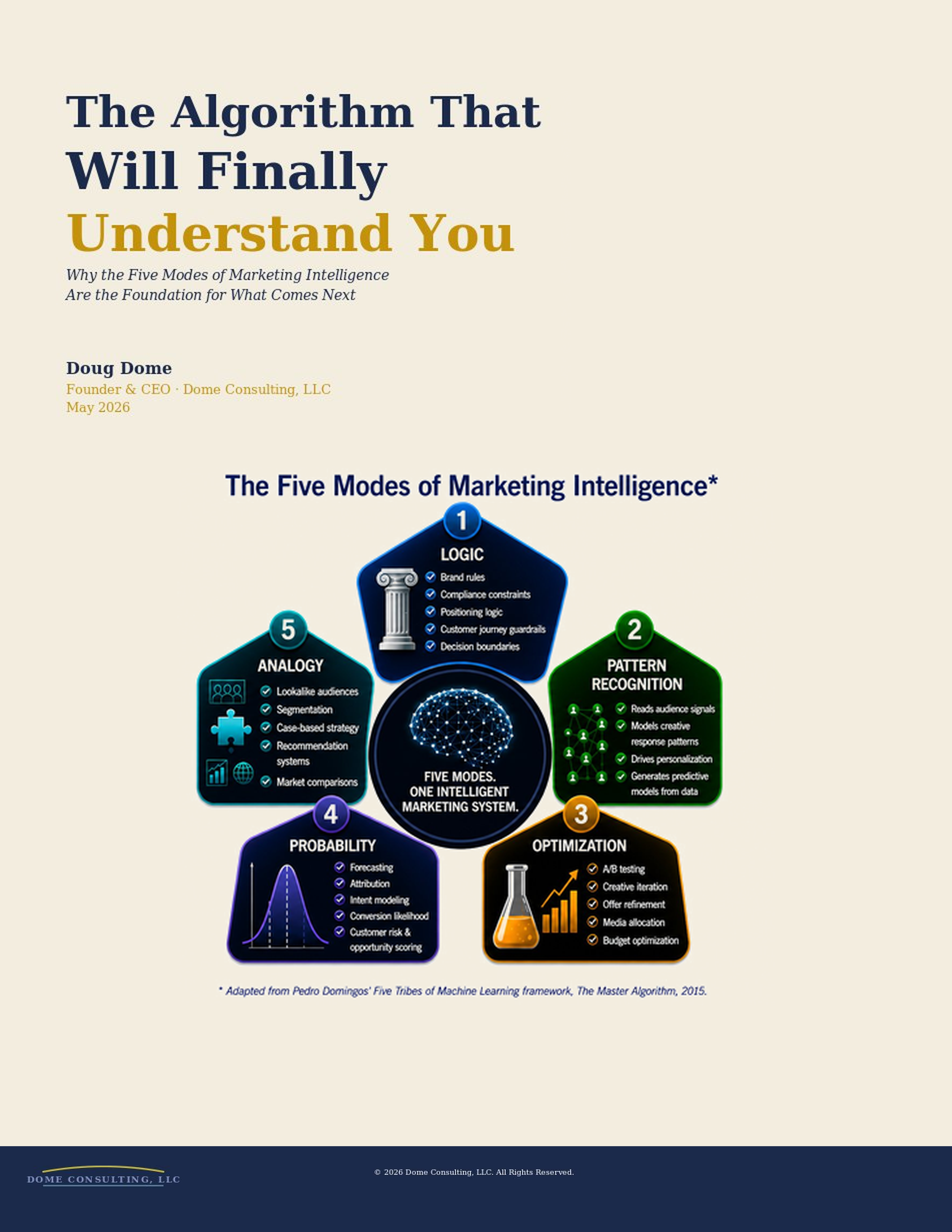
The Algorithm That Will Finally Understand You introduces the Five Modes of Marketing Intelligence, a framework adapted from Pedro Domingos' Five Tribes of Machine Learning. Every real purchase decision draws on all five modes simultaneously: Logic, Pattern Recognition, Optimization, Probability, and Analogy. Current AI marketing systems can run one mode, maybe two. Closing that gap requires a different computational architecture. The Five Modes framework is the foundation that makes the quantum leap legible.
What Readers Will Gain
The Say-Do Gap is not a modeling failure. It is a structural limitation of classical computing, and this paper explains why.
How each of the Five Modes governs a distinct class of marketing decision, and why no platform today runs more than two of them well.
Why Google Performance Max, Meta Advantage+, and The Trade Desk's Koa are each running a partial system, and what that limitation costs.
Unifying all five modes is not an AI problem. It requires a different computational layer entirely, and the agencies that understand this first will build an insurmountable lead.
The conceptual architecture that makes the quantum computing argument in Part III not just plausible, but inevitable.
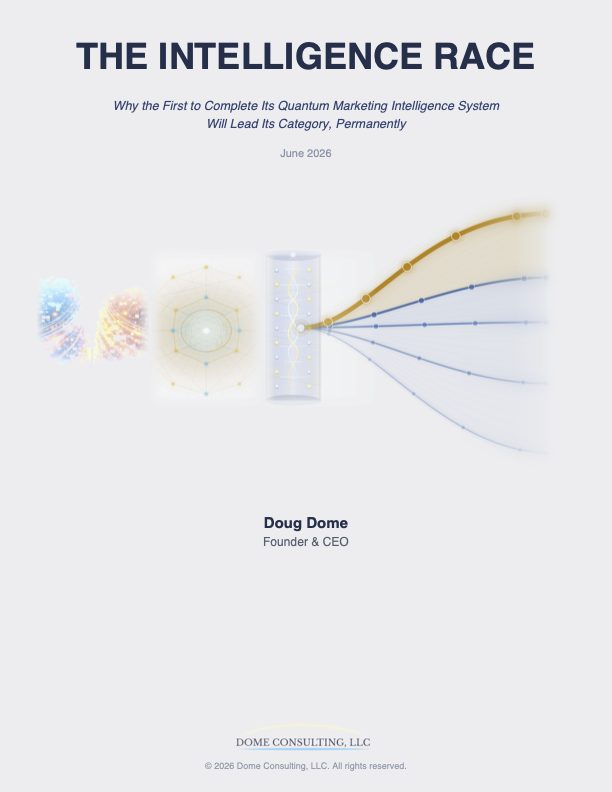
Part IV: The Intelligence Race
Why the First to Complete Its Quantum Marketing Intelligence System Will Lead Its Category, Permanently
Summary
The Intelligence Race argues that the first organization in any category to complete a quantum marketing intelligence system establishes a learning advantage that compounds permanently. The mechanism is accumulated data history. Technology is table stakes. Systems running optimization loops longer produce more accurate predictions and generate more valuable training data. That loop is self-reinforcing and structurally irreversible. The quantum transition will not reset the gap between leaders and followers. It will widen it. The race is already underway. The only question is how far behind you are willing to start.
What Readers Will Gain
Why the first-mover advantage in marketing intelligence compounds permanently, and how the mechanism works.
How the intelligence race is category-specific, and why the relevant threat is closer than most leaders assume.
What the competitive timeline actually looks like across four phases, and which phase your category has already entered.
Why the quantum transition widens the gap, and what quantum-compatible architecture requires now.
How to score your organization on the Quantum Readiness Index across five dimensions, and what your position tier means for immediate strategic priorities.
What happens to late entrants, and which of the three exit scenarios applies to your position.
Core7 Retrospective: An Early Attempt at Autonomous Marketing
Summary
This article explains how Core7 was conceived between 2014-2017 as an early marketing intelligence platform built to continuously turn data into insight, insight into strategy, and strategy into automated action. It reflects on why the venture was ahead of its time and argues that its architecture anticipated many of the capabilities now emerging in AI-driven marketing systems.
What readers will gain
Readers will gain a clear understanding of the original Core7 vision, the strategic logic behind its closed-loop architecture, and why it now stands as an early blueprint for autonomous marketing intelligence.
The Past, Present and Future of AI in Marketing
Summary
Doug’s thinking on AI in marketing was featured by the American Marketing Association in 2017, years before the current wave of adoption, in The Past, Present and Future of AI in Marketing. The article highlighted both his early conviction that AI would reshape the industry and his work on Core7.
What readers will gain
This article gives readers a clear view of AI’s journey in marketing—from early promise to real-world application—and explains why machine learning, big data, and predictive systems are reshaping how brands understand, reach, and serve customers. It also offers a forward-looking perspective on how AI could transform not just campaigns, but the entire marketing ecosystem and business model.
Summary
This timeless manifesto, written in 2003, reflects an early expression of ideas that still inform Doug’s work today: the importance of differentiation, the power of creative culture, the central role of talent, and the economic value of better ideas. It serves as an archival marker of a long-held belief that enduring advantage comes not from sameness, but from cultivating imagination, originality, and organizational conditions that allow them to thrive.
What readers will gain
Readers will gain perspective on how creativity can function as a true business asset, one that shapes positioning, performance, talent, and growth. They will also see an early framework for thinking about leadership, culture, and the internal conditions required to produce more distinctive and valuable work.
From the Archive: A Creative Manifesto
From the Archive: An Opportunity of a Lifetime
Summary
In May 2020, with COVID-19 lockdowns canceling commencement ceremonies everywhere, Doug's youngest daughter Cameryn didn't get her moment, so Doug created one. He orchestrated a full-blown mock Illinois State University commencement in the family backyard: Pomp and Circumstance, Whitney Houston on the National Anthem, an Invocation, six commencement addresses delivered by family and friends, a live musical performance, and Vitamin C's "Graduation" as the recessional. Neighbors watched from their backyards. It was the 161st Annual ISU Commencement, Class of 2020, but held at The Dome Auditorium (the backyard).
Doug had always harbored a quiet fantasy about giving a commencement address — imagining it would happen after some great professional achievement, or more likely after a generous donation to a university. A captive audience on lockdown was not what he had in mind. But as the address itself argues, the best opportunities rarely arrive on schedule. Drawing on the history of quarantine dating back to medieval Italy, and on the stories of Shakespeare and Newton — who both produced their greatest work while isolated by plague — the speech builds to a simple but powerful framework for seizing opportunity, even when the circumstances are anything but ideal. Written and delivered at Day 58 of quarantine, it is preserved here as a document of that moment.
What readers will gain
Readers will find a reframe on crisis, one that puts COVID-19 into historical context stretching back nearly 700 years to the same quarantine practices used against the Black Death in medieval Italy. From there, Doug makes the case that periods of forced stillness have always been invitations to achievement, not obstacles to it: Shakespeare wrote King Lear and Macbeth during a plague year; Newton developed calculus during the Great Plague of London.
The address also offers something practical: a five-part framework, built around Leonard Ravenhill's premise that "the opportunity of a lifetime needs to be seized during the lifetime of the opportunity," for recognizing and acting on opportunity even when it arrives in unwelcome form. And it argues that the small acts count just as much: staying safe, strengthening relationships, showing up for family. More than anything, it is a time capsule — a document of a specific emotional moment, and a reminder that remarkable things have always been done under exactly these kinds of conditions.